Welcome to the Mathematical World!
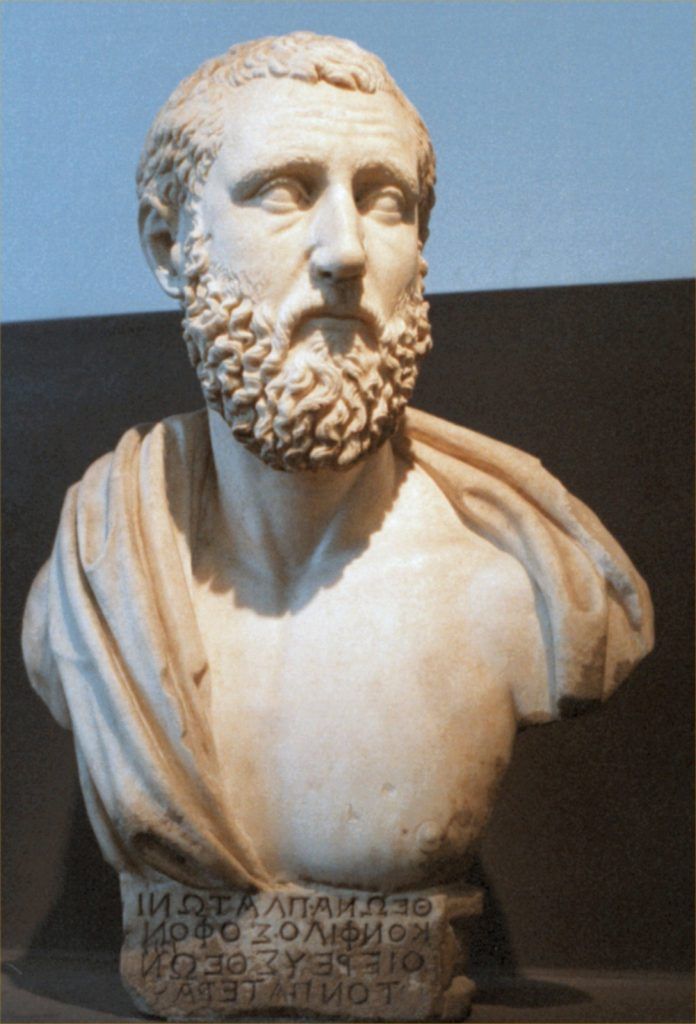
Theon of Smyrna
Philosopher-Mathematician of the Pythagorean Tradition
Not to be confused with Theon of Alexandria!!! (Clickable Link)
Theon of Smyrna (c. 70–c. 135 CE) was a Greek philosopher and mathematician whose writings reflect the enduring influence of Pythagorean thought in Late Antiquity. He is best known for his work Exposition of Mathematical Matters Useful for Reading Plato, which served as an introduction to mathematics for philosophical students.
Theon's treatise is not a book of proofs in the Euclidean tradition but a pedagogical manual explaining the mathematical background necessary for understanding Plato’s dialogues. It covers arithmetic, music theory, geometry, and astronomy—essential components of the quadrivium. In arithmetic, he discusses the classification of numbers (even, odd, prime, composite, perfect, etc.) and the relationships between them. For example, he explains the notion of perfect numbers: \[ \text{A number is perfect if } \sigma(n) = 2n, \] where \( \sigma(n) \) is the sum of divisors function.
In music theory, Theon elaborates on the Pythagorean doctrine that musical harmony is governed by numerical ratios, such as \(2:1\) for the octave, \(3:2\) for the fifth, and \(4:3\) for the fourth. He also explains geometric concepts such as means—arithmetic, geometric, and harmonic—and their philosophical significance.
Astronomy, in Theon’s presentation, follows the Platonic ideal that celestial bodies move in harmonious, mathematically describable patterns. While his astronomical content is elementary compared to Ptolemy’s, it reinforces the Pythagorean vision of a mathematically ordered cosmos.
Theon’s work was preserved through Byzantine and Arabic translations, serving as a bridge between Greek philosophy and later medieval scholarship. Although he was not an innovator of mathematical theory, his synthesis of arithmetic, geometry, music, and astronomy exemplifies how mathematics was integrated into the broader intellectual culture of his time.
His writings remind us that in antiquity, mathematics was not seen as an isolated discipline but as a pathway to understanding the universe and the philosophical truths within it.

All rights reserved by the Mathematical Unity
Contact: +8801400044645
Email: mathematicalhorse1453@gmail.com
Our Discord Server: Mathematical Unity [Ulus Riyadiyat]